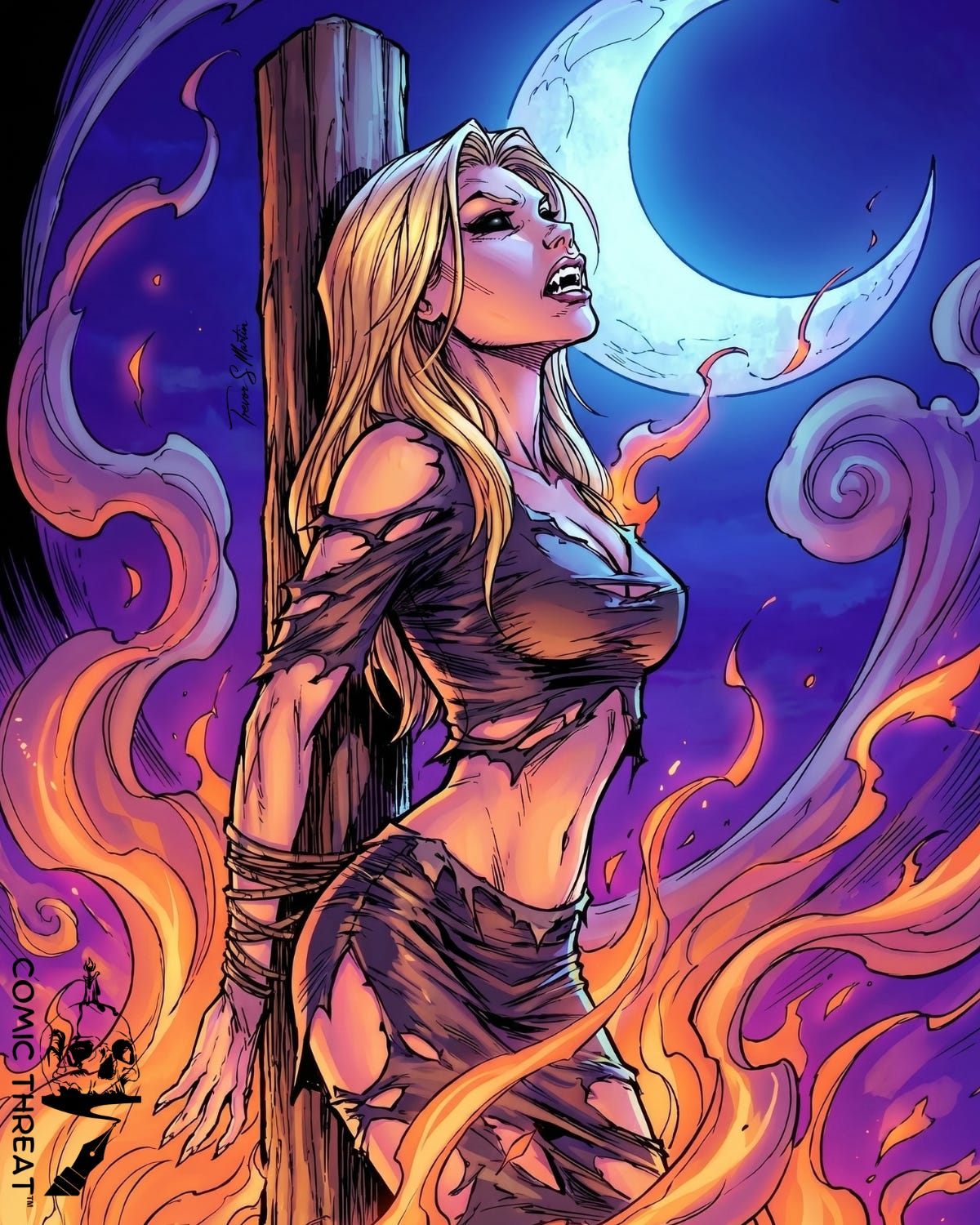
VII - The End
...."ssshhh child... don't make a sound...."

They found the little girl three days after the church burned.
She was in the root cellar beneath her family’s house, knees drawn to her chest, a dead lantern resting in her lap. She had not spoken since Veyra came through the village. Not when the men pried the door open. Not when the women wrapped her in blankets. Not when they led her past the yard where bodies were being stacked beneath sheets too small to hide anything.
She spoke only when they brought her to the grave of the man from the church.
The priest was there, and the few villagers left unbroken enough to stand. Behind them, the church rose black and hollow against the morning sky, smoke still drifting from its windows. The man lay buried beside his wife and son, and the knife he had driven into Veyra stood upright in the dirt like a promise that had failed.
The little girl stared at it for a long time.
Then she said, “She was afraid.”
No one answered. Children said strange things after horror. People allowed for that.
But the girl did not look confused. She looked certain.
“She wasn’t afraid of dying,” she said. “She was afraid of burning wrong.”
That made them listen.
The priest knelt before her carefully. “What do you mean?”
She lifted one small hand and pointed toward the woods behind the old farms, toward a patch of ground everyone knew and no one liked. It was called the bitter field. Nothing useful grew there. Garlic sprouted wild in broken white clusters, but the bulbs were veined with gray and tasted sharp enough to blister the tongue. Old stories claimed silver had been buried beneath that soil generations ago—coins, tools, offerings, fragments from some fire no one remembered clearly. After hard rains, bright flecks sometimes surfaced through the dirt.
“My mother burned some once,” the girl said. “In the stove. It smelled bad. She said it made the flame mean.”
By noon they were digging in the bitter field.
The soil stank when they turned it. Wet rot. Metal. Old roots. They gathered the gray-veined garlic in baskets and dug up tarnished scraps of silver half-swallowed by the earth, coins thinned by age, blackened buckles, spoons, bits of wire, nameless pieces of something older. The priest crushed the garlic himself. The women shaved the silver with files and stones until it glittered in basins like ground frost. Then they mixed it with oil, pitch, salt, and ash taken from the burned church floor.
By evening the yard behind the ruins smelled poisonous.
“Good,” one of the widows said. “Let it.”
They built the stake in the center of the burial field, where the dead man from the church could face it.
There was nothing elegant about it. Too much had been lost for elegance. They drove a stripped oak trunk deep into the earth and ringed it with timber, broken pew wood, fence rails, and doors torn from abandoned houses. Chains were wrapped through the center. Everything was soaked in the garlic-silver mixture until the wood shone in the dusk.
The little girl watched all of it.
When they asked whether she was sure, she nodded once.
“She’ll come,” she said…. n she was right.
Veyra came after dark. She appeared at the edge of the field where the burned grass met shadow, half her face ruined black, the wound in her chest healed into a twisted seam, her body moving with that wrong grace pain had taught her. She looked leaner now, almost starved, but there was nothing weak in her. Hunger had refined itself inside her into patience.
The villagers saw her and nearly broke.
Some stepped back. One man vomited. A woman made the sign of the cross and kept making it even after her shaking hand struck her own mouth. The priest stood before the stake in ash-stained robes, gripping a torch that looked frail in his hands.
Veyra smiled when she saw the pyre.
“That’s new,” she said.
Her voice still carried that terrible calm, as if horror repeated enough times became a kind of manners.
Then the little girl stepped out from behind the priest.
Everyone tried to stop her but no one was fast enough.
She stood in the field with soot on her dress and dirt beneath her nails and looked straight at the thing that had killed her family.
Veyra’s smile sharpened.
“You,” she said. “The window child.”
The little girl did not answer. Veyra took one step into the burial field and stopped. For the first time, something crossed her face that looked like uncertainty.
The bitter smell had reached her. Garlic, yes, but twisted into something harsher. Silver, yes, but reduced to dust and memory. Ash from sacred wood. Salt from grieving hands. A flame prepared not to ward off evil, but to make it suffer. The dark veins beneath Veyra’s skin seemed to deepen.
The priest saw it and whispered, almost to himself, “Thank God.”
Veyra turned her head and laughed.
“Don’t thank your god,” she said. “Thank the girl.”
Then she moved quicker that the priest’s prayer…she crossed the field as one man with a shovel tried to intercept her and lost his jaw. Another swung an axe and found his own arm torn free at the shoulder before the blade could fall. She hit the villagers like a blade dragged sideways through flesh…messy, intimate, spraying ruin in every direction.
The priest thrust the torch toward her face. She batted it aside and opened his belly from hip to ribs with one rake of her hand. He folded without quite understanding he had been emptied.
Panic took the rest. That had always been her ally. They scattered from the stake. Some ran toward the ruined church. Others toward the houses. Veyra went after the nearest catching the widow first, the one who had said let the fire be mean. Veyra seized her by the hair, swung her around, and smashed her face into the oak post hard enough to scatter teeth across the ground. Before the woman could fall, Veyra bit through the side of her neck and tore away a wet crescent of flesh.
Then a chain hit her from behind. The blacksmith had come low and close, looping it around her throat with both hands and all the dying courage he had left. Veyra snarled and drove her elbow backward into his ribs until they gave way like rotten kindling, but as he fell another pair of hands seized the chain, then another.
The butcher. The schoolmaster. One of the dead man’s cousins.
Men who would have run in any other story. Men too broken now to care if they lived. They pulled…Veyra went to one knee.
The little girl did not move. She stood before the pyre, small as a grave marker, watching.
Veyra saw her and something ugly flickered across her face then…recognition. The child was not screaming, not crying, not praying for rescue. She was only witnessing, and there was something in that steadiness Veyra understood too well. Pain had already entered her. It had already made a home there.
Veyra surged upward with a sound like an animal being born wrong. The chain tore skin from one man’s palms. She took the butcher’s face off with her nails. She drove her forehead into the schoolmaster’s mouth and buried his teeth down his throat.
For a moment it looked as if she might break free. Then the little girl stooped, picked up the fallen torch, and walked straight toward her. Veyra saw the flame and recoiled……just enough…enough to tell the truth.
The garlic-silver mixture had been spilled on the ground around the stake, on the chains, on the wood, on the dead woman’s dress. As the torch came near, the air itself seemed to tighten. Veyra hissed and stepped back. The blacksmith, half-collapsed and holding his side together with one hand, gave the last of his strength and threw himself at her legs.
Others followed and this time….this time the weight held.
They dragged her to the stake in a chaos of blood and screaming and blind effort. Veyra killed as they did it. She broke fingers, wrists, collarbones. Tore one man’s ear away and left it hanging by a strip. Bit through a forearm down to bone. One woman lost an eye. Another lost the skin of her cheek.
But each wound bought another second, and seconds were enough. They chained Veyra to the post.
Wrists pulled back. Ankles crossed. Waist cinched hard against the wood.
She thrashed so violently the oak trunk trembled in the ground. The chains bit into her flesh and smoked where the mixture touched her skin. Her mouth opened wider than any human thing should manage. Blood and spit hung between her teeth in red threads.
“Do it!” someone screamed. The girl stepped forward…
She came to the base of the pyre and held the torch in both hands. The light shook across her face, though not because her grip was weak. The wind had begun to rise. Ash turned between her and Veyra like black snow. Up close, the vampire no longer looked invincible. She looked terrible, yes, but also used. Torn and restitched by too many hungers. Scarred into shape. Old pain wearing new skin.
Veyra stared down at the girl.
“What did she say to you?” Veyra asked quietly.
The child blinked. “Who?”
“Your mother. Before I took her.”
The field had gone silent. The little girl swallowed. “She told me not to make a sound.”
Veyra smiled through blood. “Good woman.”
Then she leaned forward in the chains as far as they would allow and lowered her voice.
“Come give me a kiss little one.”
The girl looked at her for a long time. Slowly she let a half smile creep onto her face as she whispered back…
“Ok” and put the torch to the wood.
The flame caught wrong….at least that was what everyone said afterward, the ones who survived long enough to say anything at all. It did not rise like ordinary fire. It spread low and white at first, almost pale blue beneath, crawling through the soaked wood in veins rather than tongues. Then the silver dust flashed inside it. The garlic oil burst. The church ash lifted in sparks.
The whole pyre bloomed upward in a color no one had a name for, white at the center, green at the edges, threaded with metallic light.
Veyra screamed like a body discovering a new species of suffering. The flame did not only burn her flesh. It found whatever in her had been made by blood, ritual, and old violation and lit that too. Her skin blackened and split. Her hair vanished in a bright rush. One eye burst and ran down her cheek. The seams beneath her flesh glowed briefly like buried wire heating from within.
The smell was unspeakable. Garlic, silver, fat, rot, old blood, marrow, burnt cloth, wet hair, all of it crushed together into one foul thing that coated the tongue.
The villagers stumbled back gagging all except for the girl… she stayed.
Veyra pulled against the chains until her wrists stripped open to bone. The oak post charred behind her. Her mouth worked around screams and words and something almost like laughter. For one hideous instant she wrenched one hand half free, skin sloughing off in a burning glove as the bones of her fingers reached through the fire toward the girl.
Still, the child did not move.
The blacksmith, on his knees and barely conscious, dragged the loose chain back around the post and locked it tight again as the flame intensified. Veyra’s reaching hand caught fire down to the tendons. The fingers curled inward one by one like dying insects.
Still… she did not beg. She stared through the flames at the girl with her one remaining eye and forced herself upright against the stake as pieces of her fell away. Burning skin split from her ribs. Her jaw showed through in one place, white and grinning beneath black ruin.
Then, through a throat already cooking shut, she spoke.
“Process,” she rasped.
“Through…”
Veyra coughed, and something dark spilled from her mouth into the fire.
Then she smiled.
A horrible smile…one that was unrepentant to the last fragment.
“Pain.”
The fire ate lower and deeper. The special mixture turned the chains white-hot. Her legs collapsed first, flesh severing from itself above the knees. Her spine arched in one final convulsion so violent it looked as if something inside her were trying to climb out. Then the skull cracked with a sharp report, and what remained of her folded inward through the light.
The pyre burned until dawn.
No one left.
When the flames finally quieted, the villagers found very little at the base of the stake. A scatter of blackened bone too brittle to lift. Melted chain. A fused knot of silver slag. And at the very center, where her chest had been, a hard glassy lump the size of a fist, black with a deep red shine inside it like blood banked in stone.
The priest would have called it a relic.
The blacksmith called it cursed.
The little girl picked it up before anyone could stop her.
It was still hot to the touch…she looked at it in her palm for a long time, then walked to the grave of the man from the church and buried it there without a word. Years later, people said the bitter field grew differently. The garlic came in thick and white, the gray gone from it. Nothing harmful rooted near the place where the stake had stood. Children played there in daylight without knowing why their mothers watched from the fence line.
And every winter, on the night the village remembered but did not celebrate, the little girl, grown by then, quieter than most, harder than she should have been…walked alone to the burial field and stood between the grave of the unnamed man and the place where the stake had burned as she let her memory take hold…
…the lesson had already been written in blood, chain, smoke, and all the bodies Veyra left behind. Pain could make a religion of itself. It could crown monsters. It could hollow out the living and teach them to survive as graves.
But pain, at last, could also end, and in this end, for all her worship of it, for all the bodies she opened and all the ruin she called truth, Veyra learned what every monster learns when the fire is hot enough and the witnesses do not look away.
There is always something worse than the hunger…there is an ending.